Planting· 7 min read
Planting a tree in Irish soil
Ireland's heavy, wet soils make tree planting a little different. Here's how we do it, from digging the hole to the first year of aftercare.
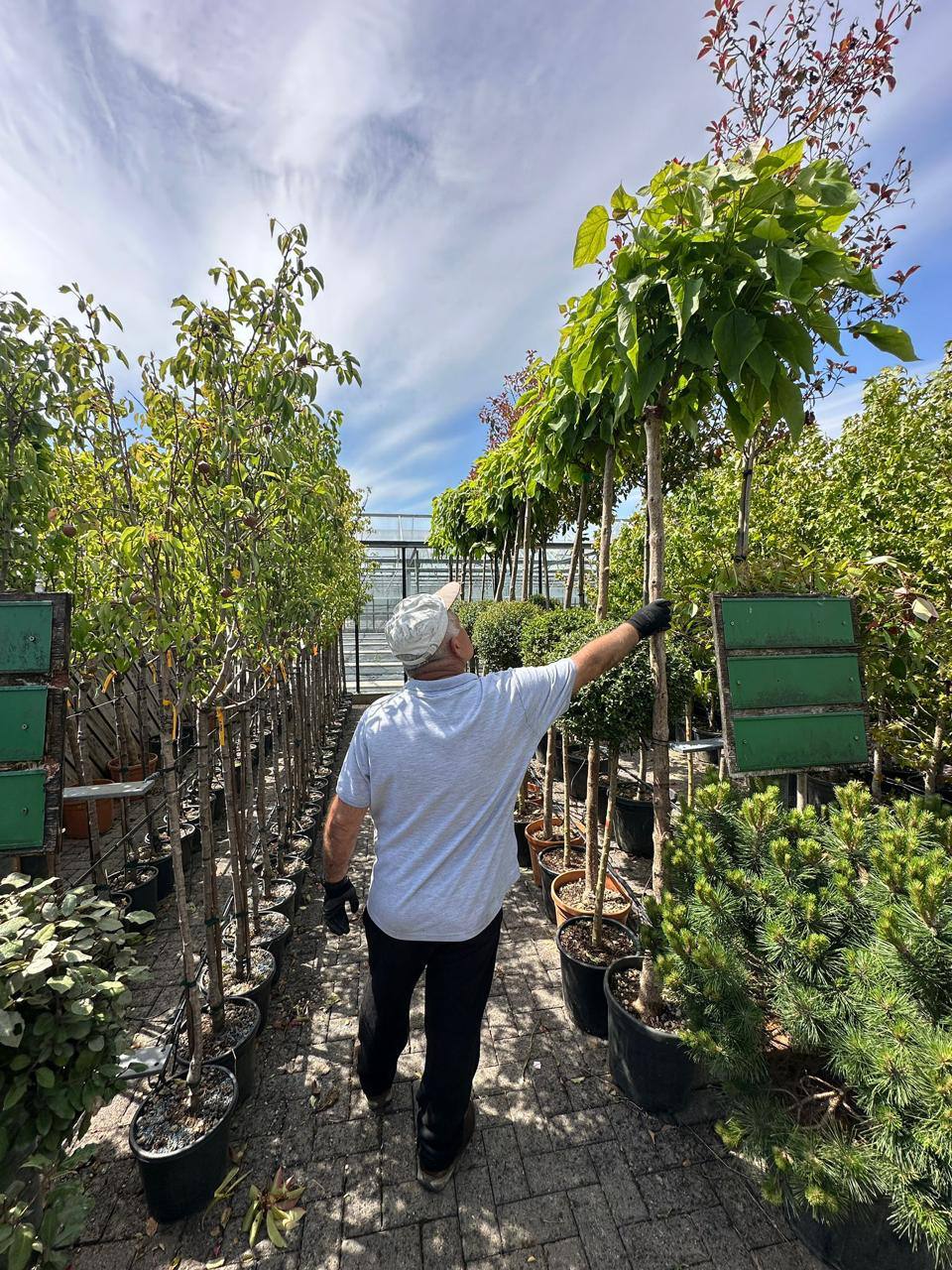
Most of Ireland's soils are heavy, moisture-retentive clays sitting on drift geology — wonderful for grass, more of a puzzle for trees. Get the first six months right and you almost never lose a tree. This is the method we use ourselves, on every job, from a single garden specimen to an avenue of a hundred limes.
Choosing the right day
The traditional planting window in Ireland runs from November to March, while trees are dormant. Bare-root and rootballed stock must go in during this window. Container-grown trees can, in theory, be planted any month of the year — but even they establish far better if you plant between October and April, while the soil is warm and moist.
Avoid planting into waterlogged ground. If you squeeze a handful of soil and water runs out, wait a week. Planting into a sump is the single most common cause of losses in the first year.
Digging the pit
Dig a square pit, not a round one — twice the width of the rootball but no deeper than the rootball itself. A square pit encourages roots to break out at the corners rather than circle around a smooth wall.
Break up the base of the pit with a fork to relieve compaction, but do not dig deeper than the rootball. If the tree sinks even 3–4cm, the trunk collar ends up buried and the tree slowly suffocates. On very heavy clay, work a bucket of coarse grit into the base for drainage.
Setting the tree
Place the tree in the pit so the top of the rootball sits 2–3cm proud of the surrounding soil — it will settle. The point where the trunk flares into the roots (the root collar) must remain visible after planting.
Backfill with the soil you took out. Do not enrich it with compost, manure or fertiliser — you want the roots to explore outward into the native soil, not curl up inside a pocket of rich stuff. Firm gently in layers with the heel of your boot as you go.
Staking
Stake low. A short stake driven in at 45° into the prevailing wind, secured with a proper rubber tie about a third of the way up the trunk, holds the rootball still while allowing the upper trunk to flex. That flexing is what builds a strong stem — a rigidly staked tree grows a weak, spindly trunk that snaps the moment the stake is removed.
Check the tie every six months and loosen it before it cuts into the bark. Remove the stake entirely after the second growing season.
The first year
Water in with a full watering can immediately after planting, even in rain — the point is to settle the soil around the roots and eliminate air pockets. Then mulch generously with bark or wood chip in a 60cm ring, 5–7cm deep, keeping the mulch clear of the trunk itself.
The critical variable in year one is watering. Even in an Irish summer a newly-planted tree can dry out in the first weeks. Water once a week, deeply — 10 to 20 litres per watering — for the entire first growing season. A five-minute splash from a hose is worse than nothing.
Do not feed in the first year. Trees invest their energy in root growth when there is no easy nitrogen at the surface. Feeding pushes soft leafy growth that the roots cannot support.
Key takeaways
- Square pit, twice as wide as the rootball, no deeper than the rootball.
- Never bury the root collar — plant slightly proud.
- Backfill with native soil, no compost or fertiliser.
- Low, angled stake with a rubber tie; remove after two years.
- Deep weekly watering for the entire first summer.
Need advice on your own planting?
We're happy to help — whether it's one tree or a full landscape scheme.
Get in touch